
Running a Sex Offender Check in Dallas County
The Alabama Law Enforcement Agency registry overview is the state starting point for a Dallas County sex offender check. ALEA's Criminal Justice Information Services Sex Offender Registry Unit publishes the Community Information Center, while local law enforcement registers each covered person and sends the state the current photograph, fingerprints, address, and other required data. The public registry is free. Dallas County does not publish a separate sheriff map or local online list, so the state search is the public web channel and the Dallas County Sheriff's Department is the local verification channel.
Start with a name when the identity is known. Use an area or city search for neighborhood awareness, or an internet-identifier search when that is the only known fact. A result is a public registration profile, not the full court file or an ALEA criminal-history record. Compare aliases, physical details, conviction jurisdiction, and status before assuming two similar names refer to the same person. For the filed charge and disposition behind a Dallas County case, consult the Dallas County criminal court case record and the Dallas County Circuit Clerk.
Dallas County Quarterly Registration
Dallas County registration is handled through local law enforcement. ALEA says an adult registrant reports in the birth month and every three months after that. Covered changes, such as a new residence or other required information, generally must be reported in person within three business days. Local staff then transmit the update to ALEA. This chain matters because the state page can only reflect the data sent by the registering agency. The official county directory confirms the local government route.
Dallas County Sheriff's Department
102 Church Street
Selma, AL 36702
(334) 874-2530
Weekdays, 8:00 a.m. to 4:30 p.m.
No appointment rule or payment method is posted. Call before visiting about registration or address verification.
Alabama Code §15-20A-22 states a $10 fee to each registering agency at quarterly registration. Dallas County has not posted local payment instructions, so confirm the accepted method first. This office is also the right local contact when a Dallas County address appears incorrect.
Note: The sheriff's public contact page does not identify a separate registry-unit name, so the main office contact is the verified route.
Searching the Alabama Sex Offender Registry
The state-authorized Community Information Center offers several paths into the Alabama Sex Offender Registry. Its vendor blocked automated inspection during Dallas County research, so exact radius choices and button labels were not guessed. The modes below are confirmed through ALEA materials and the official interface. Use only the fields the live page presents.
- Open the registry from ALEA's official registry overview and read the current conditions of use.
- Choose an area, name, city, internet or email identifier, or noncompliant search that fits the facts you know.
- Review the result list carefully, using aliases and physical details to avoid a mistaken match.
- Open the public profile, check its compliance and address fields, and note the registering agency for follow-up.
| Search mode | Type | Required | Notes |
|---|---|---|---|
| Area or location | Form or tab | Live form controls | Address proximity is supported; current radius options were not verified. |
| Name | Text fields | Live form controls | First- and last-name fields are available. |
| City | Browse or form | City selection | Can narrow the public view to Selma or another listed place. |
| Internet or email identifier | Form or tab | Known identifier | Searches a public online identifier rather than a street address. |
| Noncompliant | Status filter | No exact control verified | Browses profiles carrying a noncompliance status. |
| Alert | Signup | Live form controls | Alert and proximity fields exist, but exact triggers were not verified. |
Because the live vendor interface can change, treat the table as a verified mode inventory rather than a promise about current labels. The official screen controls.
Dallas County Registry Updates
ALEA describes the public registry as updating daily in real time from local submissions. That claim does not remove the local handoff. A person reports to the Dallas County registering agency, the agency records the change, and the state system publishes what it receives. A lag, noncompliance, or absconded status can leave an old address on screen. “Compliant” only means the recorded registration duties are current. It is not a forecast of conduct or risk.
The ALEA Fugitive Search also has a public interface. The captured official screen shows why separate state tools should not be merged in the reader's mind.
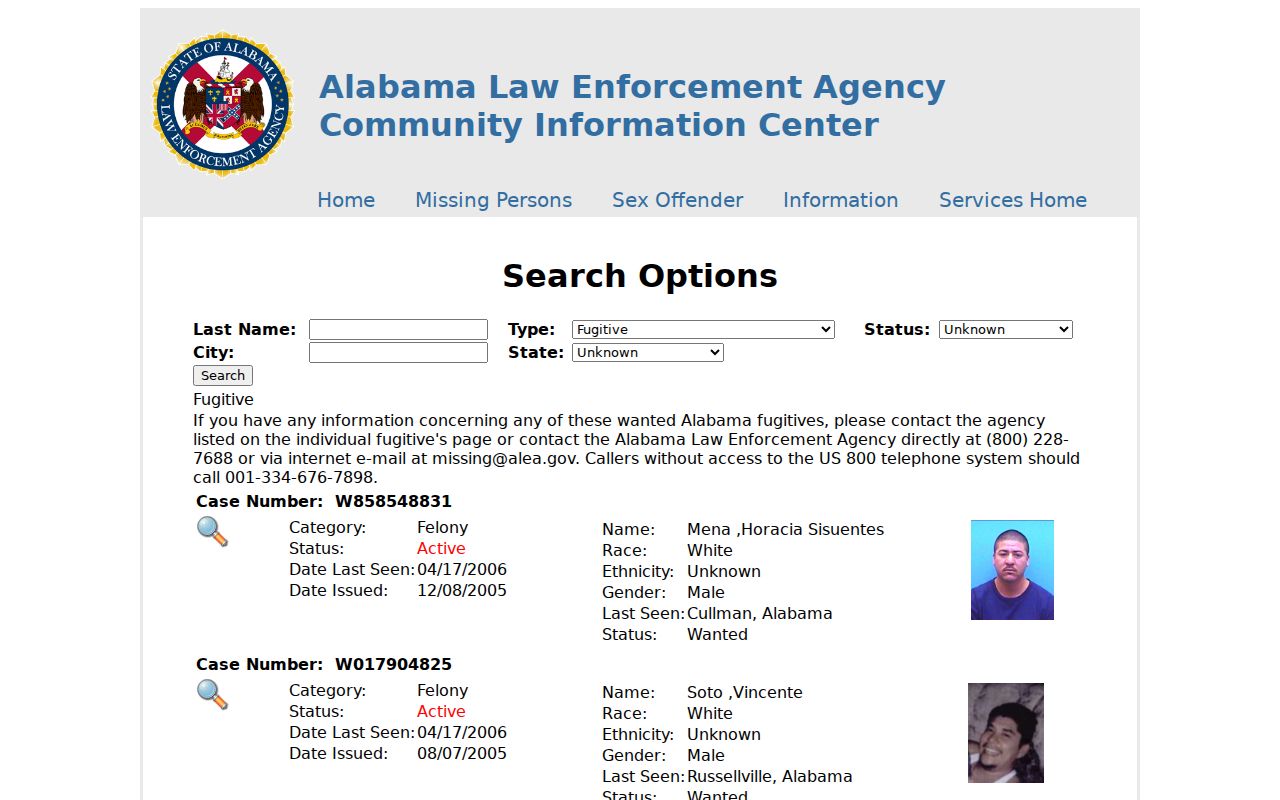
ALEA Fugitive Search is a selected-publicity supplement. It is not the Alabama Sex Offender Registry, not a complete warrant list, and not a replacement for the Dallas County Sheriff's Department.
What a Registry Profile Shows
A public profile can provide enough detail to distinguish a person and understand why registration applies. It may show a photo, names and aliases, age or date-of-birth display, physical description, identifying marks, residence or homeless status, compliance, offense data, vehicles, online identifiers, and the registering agency. Public work or school facts may also appear where Alabama law permits them. The profile should be read as a current public extract, not an unrestricted case or intelligence file.
| Name and aliases | Reported legal name and other names used for matching. |
|---|---|
| Photo and description | Current submitted image plus sex, race, hair, eyes, height, weight, marks, or tattoos when publicly displayed. |
| Registered location | Residence or homeless-status information allowed for public display. |
| Offense details | Qualifying offense, statute, conviction jurisdiction, and conviction information made public by law. |
| Other public facts | Legally public vehicle, work, school, or internet-identifier information. |
| Registration status | Compliance, noncompliance, or absconded status and the named registering agency. |
The Alabama administrative registration-data rule lists the broader information collected by the state. The official image preserves that distinction.
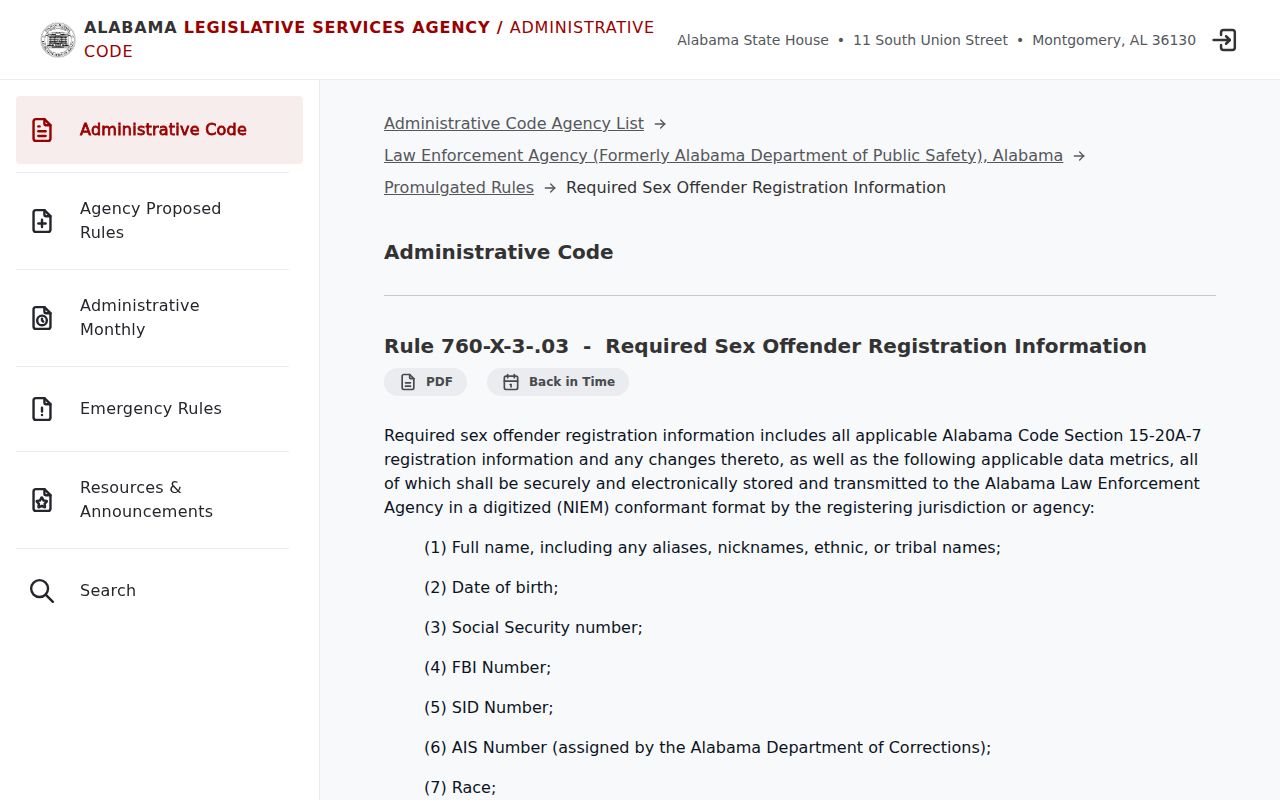
Internal categories can include Social Security, SID, FBI, AIS, and victim information. Do not assume those protected items appear on a Dallas County public profile.
Dallas County and NSOPW Searches
The ALEA registry is the best source for Alabama-specific profile detail. The U.S. Department of Justice's National Sex Offender Public Website, or NSOPW, is the cross-state layer. It is useful when a person may have moved, when an address lies near a county or state boundary, or when the correct state is not yet clear. NSOPW gathers public data from participating jurisdictions, then routes users back toward the source registry for current detail.
The official NSOPW search shows the national interface used for that wider check.
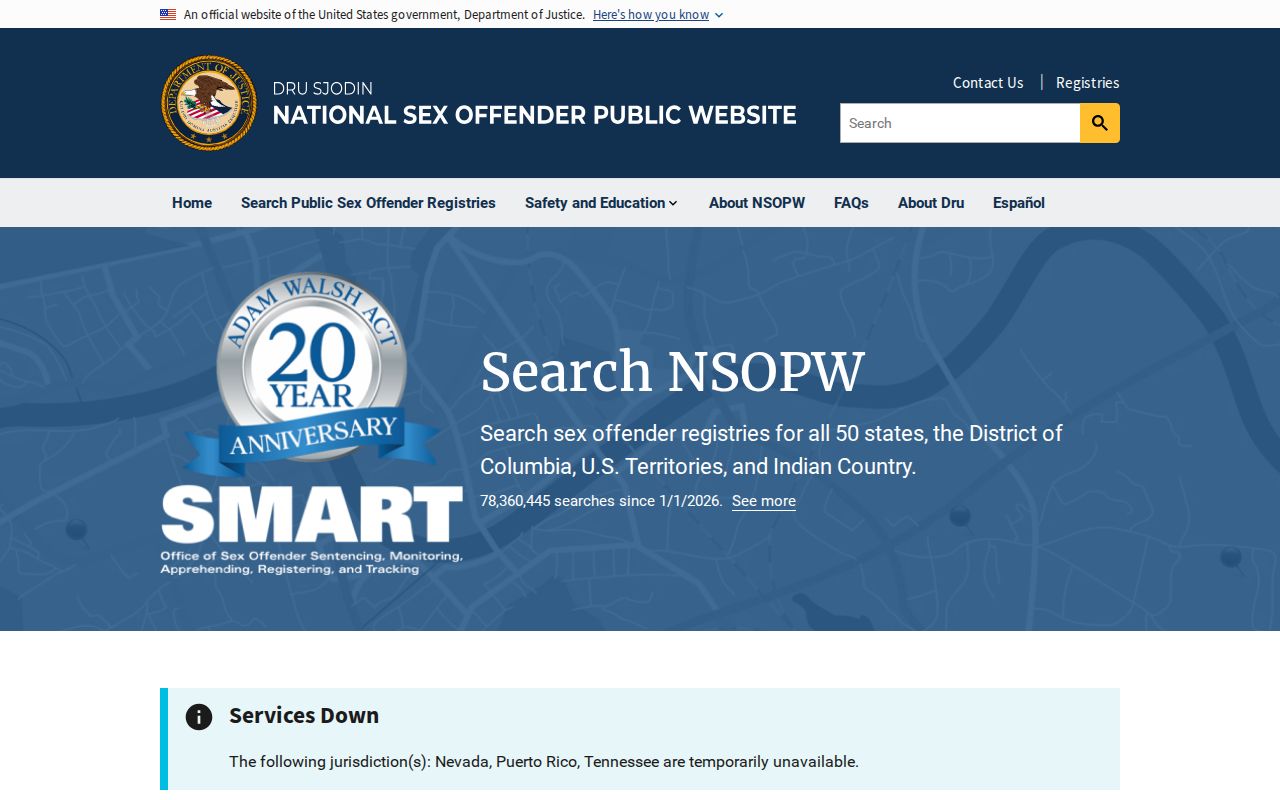
A national match should be confirmed in the originating jurisdiction. For a Dallas County entry, return to ALEA and call the Dallas County Sheriff's Department if the location or compliance status needs local review.
Registration Requirements and Levels in Alabama
Alabama does not give adults a simple public Tier I, Tier II, or Tier III label. Adult duties under the Alabama Sex Offender Registration and Community Notification Act are generally lifetime, with narrow petition-based relief. Juvenile rules differ. Enumerated serious cases involving a person age 14 or older can carry lifetime duties with a petition possible after 25 years. Other juvenile duties are generally 10 years, and juvenile risk assessment uses Low, Moderate, or High. Those juvenile ratings should not be recast as adult public tiers.
| Alabama category | General duration | Reporting or review |
|---|---|---|
| Adult ASORCNA registrant | Generally lifetime, with narrow statutory petition relief | Birth month and every three months afterward; covered changes generally in person within three business days |
| Enumerated serious juvenile case, age 14+ | Can be lifetime | Petition may be available after 25 years under the governing conditions |
| Other covered juvenile case | Generally 10 years | Juvenile assessment uses Low, Moderate, or High |
Not every sex-offense conviction appears in a public Dallas County result. Display depends on Alabama Code §15-20A-5. Juvenile and Youthful Offender treatment, offense-list limits, and due-process status for some out-of-state cases can bar publication. ALEA also says a first conviction for indecent exposure or sexual misconduct is not posted. An absent profile is therefore not proof that no case exists.
Dallas County Distance Rules
A registry map radius is a search filter. It is not the same as a legal residence or community-notification distance. Alabama Code §15-20A-11 generally restricts a covered residence within 2,000 feet of school or childcare property, subject to the statute's exceptions and relief rules. ALEA separately notes a 500-foot loitering rule around specified child-centered places when the victim was under 12. Each rule has its own scope.
Alabama Code §15-20A-21 sets local community-notification distances. The official captured statute page is a sound source for the current text.
Outside Alabama's four largest named cities, a city with at least 5,000 residents uses the statute's 1,500-foot resident-notification rule and three-mile school and childcare notification. Selma falls in that population band, but readers should rely on the current statute and local law enforcement rather than convert a portal circle into legal advice.
Note: Search distance controls what appears on a map; statutory distance rules govern conduct and notification under defined facts and exceptions.
Wrong Dallas County Registry Address
Do not visit the address or confront the person. First, recheck that the profile matches the right individual and note the compliance status, registering agency, and date shown. An old address can reflect a reporting delay, noncompliance, or absconded status. Contact the Dallas County Sheriff's Department at (334) 874-2530 when Dallas County is the registering jurisdiction. Give staff the public profile link and explain the specific address issue without publishing private details elsewhere.
For the state publication layer, use ALEA's registry guidance and reporting directions. A law-enforcement report lets the agency check information that a member of the public cannot see. It also avoids the risk of mistaken identity or unsafe contact. If the profile names another registering agency, report the concern there instead of assuming Dallas County controls the record.
Lawful Use and Community Notification
The Alabama Sex Offender Registry supports personal safety and community awareness. It does not authorize threats, punishment, public shaming, or self-directed enforcement. Use the public facts to make calm safety plans and to contact law enforcement about a concrete compliance or address concern. Do not treat registration status as a prediction, and do not infer that a person absent from the public site has no qualifying history.
Use registry information lawfully. Do not harass, threaten, intimidate, discriminate against, or confront a registrant or household. Report suspected noncompliance to law enforcement. Alabama research identified no separate registry-specific harassment statute, so no such citation is claimed here; ordinary criminal laws and other applicable legal limits still govern misuse.
Community notices and public profiles can change as local agencies submit updates. Verify a Dallas County status through ALEA and the Dallas County Sheriff's Department before relying on it. For a broader view of the county's official record channels, the Dallas County criminal history overview explains how sheriff, court, and state records differ.