
Criminal Cases in the Dallas County Courts
Dallas County criminal cases are divided by court and charge. The Dallas County Circuit Court, part of Alabama's Fourth Judicial Circuit, has felony jurisdiction and can hear lesser offenses tied to a felony. District Court handles most county misdemeanors, felony preliminary hearings, and certain noncapital felony pleas before indictment. Rule 2.2 of the Alabama Rules of Criminal Procedure sets out that division. A case filed under one court should not be assumed to appear as a separate file in another.
The Circuit Clerk at 105 Lauderdale Street in Selma keeps Circuit and District criminal files. The office says it maintains records for seven courts. Public counter hours are 8:00 a.m. to noon and 1:00 to 4:30 p.m. on Monday, Tuesday, Thursday, and Friday. It is closed to the public each Wednesday. Selma Municipal Court separately handles city ordinance, traffic, and adopted state misdemeanor matters within Selma. Juvenile cases are confidential and do not form part of the normal adult criminal docket.
Dallas County Case Records Split
A missing Dallas County court case can be a routing problem, not proof that no proceeding took place. A felony may begin with District Court papers, move through a grand jury, and continue in Circuit Court. A Selma misdemeanor can remain in Municipal Court instead. The clerk's role across seven courts does not turn those dockets into one undivided database.
Start with the charge level and location. Contact the Circuit Clerk for felony, District misdemeanor, preliminary-hearing, and county traffic files. Contact Selma Municipal Court for city cases, especially ordinance, municipal traffic, or adopted misdemeanor matters. Ask about archived or non-imaged records when a paid online search returns no useful file. Give the full name, an approximate filing year, and a case or citation number if known. This court-first method avoids mistaking a municipal record gap for a clean county search.
Note: An arresting agency's report and a court's filed case are distinct records, even when they concern the same event.
How to Search Case Records
Just One Look / Alacourt Access provides one-time paid public access to available Alabama trial-court records. A name or case-number search costs $9.99 and includes one case detail. Each added case costs $9.99, and a no-match search is still billable. Documents cost $5 for the first 20 pages and $0.50 for each later page. The online result is a dated convenience copy. The Dallas County Circuit Clerk remains the source for the official file and certified copies.
- Create a Just One Look account, then decide whether a name or known case number is the sounder search key.
- Search the Dallas County criminal docket. Check spelling and do not assume a Selma municipal matter will appear there.
- Open the case detail and confirm the court, case identifier, parties, status, settings, and financial entries match the matter sought.
- Read the case-action summary and available attachments. Save the purchase date because the snapshot does not update on its own.
- Call the Circuit Clerk at (334) 874-2523 for older files, missing images, certification, or the current copy cost before sending payment.
| Portal field | Type | Required | Verified use |
|---|---|---|---|
| Name | Search mode | One search mode | Finds possible party matches; spelling matters |
| Case Number | Search mode | One search mode | Targets a known case identifier |
| Account email | Text | Yes at signup | Used for account access and purchase history |
| Name and address | Text fields | Yes at signup | First, middle, last, street, city, state, and ZIP |
| Phone and terms | Text and checkbox | Yes at signup | Completes the verified registration fields |
Older Dallas County Case Files
Online access depends on what the clerk has indexed and imaged. When an old Dallas County criminal case has no image, use the clerk's counter or mail route. The courthouse is at 105 Lauderdale Street, Selma, AL 36701. Mail goes to P.O. Box 1148, Selma, AL 36701. The clerk's phone is (334) 874-2523. State the case number, defendant name, rough filing year, exact document, preferred format, and whether certification is needed.
Dallas County does not publish a dedicated criminal-copy form or a criminal plain-copy, certified-copy, archive, transcript, or mail-search fee schedule. Staff must quote the current cost and explain payment before a request is sent. Do not apply the $10 certified divorce-decree example found elsewhere on the clerk's site to a criminal file. When authenticity matters, a clerk-certified judgment or case-action summary is stronger than a portal screenshot because it comes from the office that holds the operative record.
What the Case File Shows
A Dallas County criminal case file records the court process, not merely the arrest. Just One Look advertises basic case information, actions and rulings, status, settings, parties, financial history and costs, a detailed case-action summary, images, and attachments. The exact set varies with the documents filed, public-access rules, and what the clerk has imaged. Read the docket as a timeline, then open the judgment or order that supports an outcome instead of treating a brief status label as the whole result.
| Case Number and Court | Identifies the filing court, year, case type, and sequence used to locate the official file. |
|---|---|
| Charging Document | May be a complaint, information, or grand-jury indictment stating the charge brought to court. |
| Docket Entries | Chronological filings, notices, motions, rulings, and other case-action events. |
| Hearing Dates | Settings for initial appearance, preliminary hearing, arraignment, pretrial proceedings, plea, or trial. |
| Disposition and Judgment | Shows whether a count remains pending or ended by dismissal, acquittal, plea, or judgment of guilt. |
| Sentence and Conditions | Records punishment and may include custody, probation, restitution, fines, costs, or related terms. |
Dallas County Disposition Terms
Small differences in docket language can change the meaning of a Dallas County case. “Pending” describes the current posture, not guilt. A disposition is the outcome or status of a charge. The filed order should control when a short portal label and a reader's assumption do not match.
- Nolle prosequi
- The prosecutor declines to continue the charge at that point.
- Acquittal
- A not-guilty result after adjudication.
- Dismissal with prejudice
- The charge cannot be refiled in that action.
- Dismissal without prejudice
- The charge may be refiled when law permits.
- Conviction
- A judgment of guilt, which is different from an arrest or open charge.
- Expungement
- A court-ordered remedy that removes eligible records from ordinary public criminal-history access.
Check each count. One Dallas County case can contain more than one charge, and each may end differently. A broad “disposed” label only means the court has acted; it does not identify which result applies.
Stages of a Criminal Case
A Dallas County felony record may begin with a complaint and initial court papers. After a probable-cause finding, waiver, or no timely preliminary-hearing demand, the Fourth Judicial Circuit District Attorney presents the felony complaint to the grand jury under Rule 5.4. A returned indictment then states the grand jury's accusation. At arraignment, the charge is stated and a plea is taken. Motions, evidence issues, negotiation, trial, and final orders create later docket entries.
Case flow: Charges Filed › Arraignment › Pretrial › Plea or Trial › Disposition › Sentencing
A warrantless arrest also requires a judicial probable-cause decision without undue delay and no later than 48 hours. A felony defendant has 30 days after arrest to demand a preliminary hearing, and a timely demanded hearing generally begins within 21 days. Those rules describe procedural deadlines, not a forecast of the full case length.
Certified Dallas County Expungement Records
Alabama's CR-65 expungement petition calls for certified arrest or disposition material and a certified ALEA history. That makes the Dallas County clerk file an early step for a person reviewing a potentially eligible case. The current form asks for the court, county, case, exact charge or conviction, result, arresting and booking agencies, prior expungements, and other facts tied to eligibility.
The ALEA criminal-record expungement page shows the state repository side of that process.
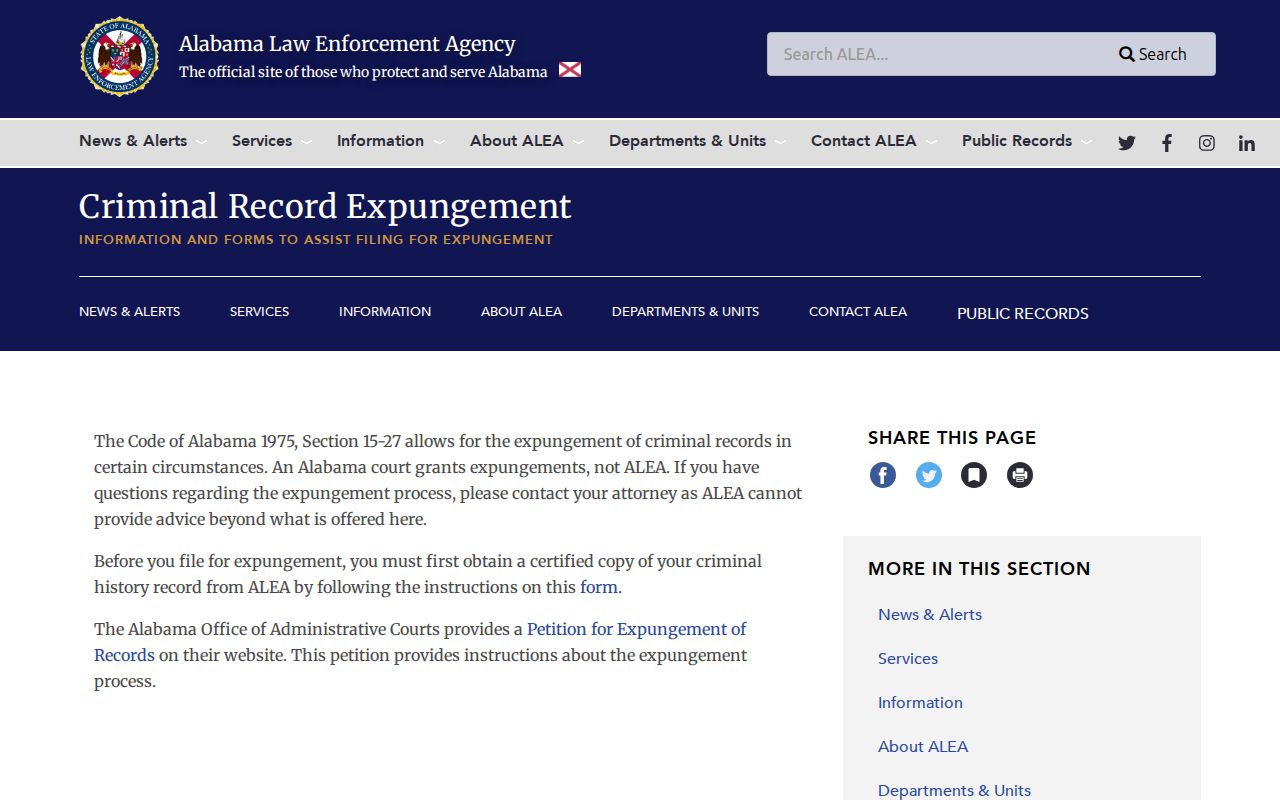
The captured state page helps distinguish the ALEA record step from filing the petition in Dallas County Circuit Court. Current statewide material reflects a $500 filing amount unless indigency relief applies, while an older Dallas page still says $300. Confirm the current sum with the clerk rather than relying on the stale local figure.
Missing Dallas County Warrant Cases
An unserved Dallas County arrest warrant is not public. That rule explains why a suspected warrant may not appear in an open case search. A person who thinks a warrant exists must appear at the Dallas County Sheriff's Department at 102 Church Street and may call (334) 874-2530 for directions. The ALEA Fugitive Search is only a selected-publicity list, not a full warrant clearance tool.
Once served, warrant, complaint, initial-appearance, and bond papers may become part of the court trail, subject to access rules. Selma municipal bench-warrant questions belong with Selma Municipal Court. County traffic material also warns that missing court or failing to pay can lead to an alias warrant and license action without prior notice. A missing portal entry therefore calls for the right official office, not a conclusion about whether process exists.
Note: Never pay a caller who claims ALEA will take a card payment to cancel a warrant; ALEA warns that is a scam.
Access & Restrictions
Ala. Code §36-12-40 gives Alabama citizens a right to inspect and copy public writings unless another law creates an exception. Section 36-12-41 provides for a certified copy of an inspectable record when lawful fees are paid. Court access also follows the Alabama Rules of Court-Record Privacy and Confidentiality. Public versions normally redact Social Security numbers and protected victim or minor identifiers.
Juvenile, Youthful Offender, sealed, and expunged files do not appear as ordinary adult Dallas County criminal case records. Some investigative material and personal data can also be withheld. A blank search may reflect the wrong court, an archived or non-imaged file, a protected matter, spelling, or a lag in case data. Ask the clerk about the official file and the legal basis for any limit. A public court file is also distinct from compiled ALEA Criminal History Record Information, whose dissemination is governed by Ala. Code §41-9-636.
For a person's own statewide fingerprint-linked history, ALEA's Application to Review Alabama Criminal History Record Information is the proper route. That self-review can reveal a missing disposition, but the certified Dallas County judgment supplies the court proof needed to challenge a repository error. No public portal result should replace the originating court record.